
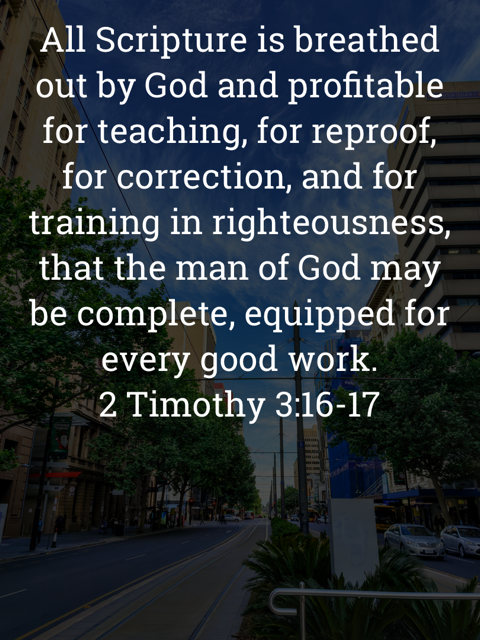
Devotion on 2 Timothy 3:16–17
2 Timothy 3
English Standard Version
Godlessness in the Last Days
3 But understand this, that in the last days there will come times of difficulty. 2 For people will be lovers of self, lovers of money, proud, arrogant, abusive, disobedient to their parents, ungrateful, unholy, 3 heartless, unappeasable, slanderous, without self-control, brutal, not loving good, 4 treacherous, reckless, swollen with conceit, lovers of pleasure rather than lovers of God, 5 having the appearance of godliness, but denying its power. Avoid such people. 6 For among them are those who creep into households and capture weak women, burdened with sins and led astray by various passions, 7 always learning and never able to arrive at a knowledge of the truth. 8 Just as Jannes and Jambres opposed Moses, so these men also oppose the truth, men corrupted in mind and disqualified regarding the faith. 9 But they will not get very far, for their folly will be plain to all, as was that of those two men.
All Scripture Is Breathed Out by God
10 You, however, have followed my teaching, my conduct, my aim in life, my faith, my patience, my love, my steadfastness, 11 my persecutions and sufferings that happened to me at Antioch, at Iconium, and at Lystra—which persecutions I endured; yet from them all the Lord rescued me. 12 Indeed, all who desire to live a godly life in Christ Jesus will be persecuted, 13 while evil people and impostors will go on from bad to worse, deceiving and being deceived. 14 But as for you, continue in what you have learned and have firmly believed, knowing from whom[a] you learned it 15 and how from childhood you have been acquainted with the sacred writings, which are able to make you wise for salvation through faith in Christ Jesus. 16 All Scripture is breathed out by God and profitable for teaching, for reproof, for correction, and for training in righteousness, 17 that the man of God[b] may be complete, equipped for every good work.
- 2 Timothy 3:14 The Greek for whom is plural
- 2 Timothy 3:17 That is, a messenger of God (the phrase echoes a common Old Testament expression)
The ESV® Bible (The Holy Bible, English Standard Version®), © 2001 by Crossway, a publishing ministry of Good News Publishers. ESV Text Edition: 2025.
1. Exegesis
The setting. Paul writes as a suffering apostle nearing the end of his ministry. He urges Timothy to remain faithful to the gospel rather than follow deceptive teachers. Chapter 3 contrasts outward religion and corrupt conduct with persevering faith, faithful teaching, and endurance. The answer to deception is not novelty but continuing in the truth Timothy has received, including the Scriptures known since childhood (2 Timothy 1:8–14; 3:1–15; 4:1–8).
- Divine origin, not merely religious usefulness. The English Standard Version presents verse 16 as an assertion about Scripture as a whole: its source is God, and it is therefore beneficial. Paul does not divide Scripture into inspired and uninspired portions. The Greek adjective theopneustos describes divine origin; it does not mean that readers make Scripture inspired by responding to it.
- The scope of Scripture. Timothy’s childhood Scriptures were principally the Old Testament. Paul does not list the completed New Testament canon here. Applying this principle to both Testaments rests on the wider biblical witness to apostolic revelation and the recognition of apostolic writings as Scripture (2 Peter 1:20–21; 3:15–16).
- Four interrelated purposes. Teaching establishes truth; reproof exposes false belief and wrongdoing; correction redirects us towards what is right; and training develops sustained righteous conduct. Scripture does more than inform the mind: it reshapes belief, behaviour, and habits.
- Preparation for service. Verse 17 explains the purpose of these activities. The designation for God’s servant refers first to Timothy in his ministry and echoes an Old Testament expression for God’s messenger. The principle also shapes Christian discipleship more broadly. The emphasis is fitness and thorough preparation, not sinless perfection or mastery of every subject (2 Timothy 2:21–26; 4:1–5).
The gospel connection. Verse 15 governs how we approach verses 16–17: Scripture directs people towards salvation through faith in Jesus Christ. Its moral instruction must not become a programme for earning acceptance with God. We receive grace in Christ and are then formed for obedient service (2 Timothy 1:9–10; 3:15–17).
2. Theological teaching
- Authority and truthfulness. Scripture’s authority rests on God, not on a reader’s feelings or the church’s approval. Christian theology understands inspiration as God’s work through genuine human authors. Its confession of Scripture’s complete truthfulness follows from divine authorship and God’s truthfulness; these two verses do not themselves explain every question about manuscripts or interpretation (2 Peter 1:20–21).
- Sufficiency with a defined purpose. Scripture supplies the authoritative truth necessary for salvation, faith, and obedient living. It is not an exhaustive manual for medicine, technology, or every personal decision. Christian judgement still uses sound knowledge and wise counsel under biblical principles.
- Grace before good works. God saves through Christ, not through our achievement. Good works are the fruit of salvation, not its price. Scripture equips believers for this grace-enabled obedience (2 Timothy 1:9–10; Ephesians 2:8–10).
- The Spirit and the church. Inspiration concerns Scripture’s origin; illumination is the Holy Spirit’s work enabling us to understand and receive its truth. Prayerful study, faithful preaching, and learning with the church belong together. Illumination does not make our interpretations infallible (2 Timothy 1:14; 2:2, 7).
3. Practical application
- Read for understanding, not isolated reassurance. Read a paragraph or chapter before drawing conclusions from a single verse. Ask how the passage relates to Christ and the argument of its book.
- Test what reaches you. Compare sermons, podcasts, social media claims, and attractive spiritual advice with Scripture. Popularity, confidence, and emotional impact do not establish truth.
- Receive correction with hope. When Scripture exposes impatience, pride, dishonesty, or selfishness, confess it and seek change. Correction is part of God’s fatherly care, not a demand to earn his love.
- Turn learning into one concrete response. Apologise where needed, speak honestly, serve someone quietly, or establish a habit of prayer. Discuss difficult applications with a trusted Christian rather than relying only on private impressions (James 1:22–25).
- Persevere without expecting an easy life. God’s Word equips us for faithfulness amid suffering, not immunity from hardship. If you feel weary, begin with a manageable reading rhythm and seek support from your church (2 Timothy 3:10–14).
4. Meditation guide
Allow about ten minutes. You do not need to manufacture a special feeling; approach God honestly and attentively.
- Prepare. Ask the Holy Spirit for understanding, humility, and willingness to obey.
- Read. Read 2 Timothy 3:14–17,
14 But as for you, continue in what you have learned and have firmly believed, knowing from whom you learned it 15 and how from childhood you have been acquainted with the sacred writings, which are able to make you wise for salvation through faith in Christ Jesus. 16 All Scripture is breathed out by God and profitable for teaching, for reproof, for correction, and for training in righteousness, 17 that the man of God may be complete, equipped for every good work.
then review the whole chapter.
3 But understand this, that in the last days there will come times of difficulty. 2 For people will be lovers of self, lovers of money, proud, arrogant, abusive, disobedient to their parents, ungrateful, unholy, 3 heartless, unappeasable, slanderous, without self-control, brutal, not loving good, 4 treacherous, reckless, swollen with conceit, lovers of pleasure rather than lovers of God, 5 having the appearance of godliness, but denying its power. Avoid such people. 6 For among them are those who creep into households and capture weak women, burdened with sins and led astray by various passions, 7 always learning and never able to arrive at a knowledge of the truth. 8 Just as Jannes and Jambres opposed Moses, so these men also oppose the truth, men corrupted in mind and disqualified regarding the faith. 9 But they will not get very far, for their folly will be plain to all, as was that of those two men.
All Scripture Is Breathed Out by God
10 You, however, have followed my teaching, my conduct, my aim in life, my faith, my patience, my love, my steadfastness, 11 my persecutions and sufferings that happened to me at Antioch, at Iconium, and at Lystra—which persecutions I endured; yet from them all the Lord rescued me. 12 Indeed, all who desire to live a godly life in Christ Jesus will be persecuted, 13 while evil people and impostors will go on from bad to worse, deceiving and being deceived. 14 But as for you, continue in what you have learned and have firmly believed, knowing from whom you learned it 15 and how from childhood you have been acquainted with the sacred writings, which are able to make you wise for salvation through faith in Christ Jesus. 16 All Scripture is breathed out by God and profitable for teaching, for reproof, for correction, and for training in righteousness, 17 that the man of God may be complete, equipped for every good work.
Notice the contrast between deception and steadfast faith. - Reflect. What does Scripture’s divine origin mean for the authority I give it? Where do I need instruction, exposure of error, redirection, or patient training? Am I approaching God through Christ or trying to prove my worth?
- Respond. Identify one specific act of obedience for today. Write it down, and consider who could encourage you to follow through.
- Pray. Father, thank you for giving your Word and for saving me through Jesus Christ. Help me receive your truth, recognise my errors, and accept your correction. By your Spirit, grow steady obedience in me. Equip me to serve others with humility and love. Amen.
- Return. At the end of the day, review your response without self-condemnation. Give thanks for grace, confess failures, and ask for renewed strength.
Unless otherwise indicated, all Scripture quotations are from the ESV® Bible (The Holy Bible, English Standard Version®), © 2001 by Crossway, a publishing ministry of Good News Publishers. ESV Text Edition: 2025. Used by permission. All rights reserved.
Discover more from Daily bible verses
Subscribe to get the latest posts sent to your email.


You must be logged in to post a comment.