
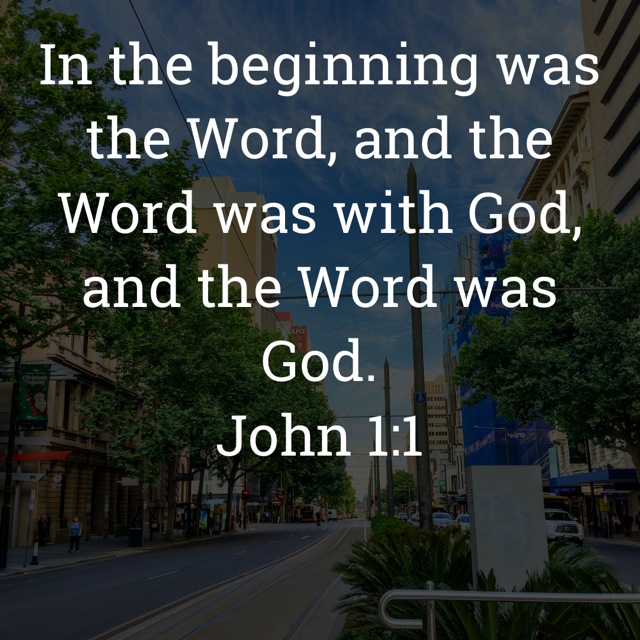
John 1:1: The eternal Word and our living hope
John 1
English Standard Version
The Word Became Flesh
1 In the beginning was the Word, and the Word was with God, and the Word was God. 2 He was in the beginning with God. 3 All things were made through him, and without him was not any thing made that was made. 4 In him was life,[a] and the life was the light of men. 5 The light shines in the darkness, and the darkness has not overcome it.
6 There was a man sent from God, whose name was John. 7 He came as a witness, to bear witness about the light, that all might believe through him. 8 He was not the light, but came to bear witness about the light.
9 The true light, which gives light to everyone, was coming into the world. 10 He was in the world, and the world was made through him, yet the world did not know him. 11 He came to his own,[b] and his own people[c] did not receive him. 12 But to all who did receive him, who believed in his name, he gave the right to become children of God, 13 who were born, not of blood nor of the will of the flesh nor of the will of man, but of God.
14 And the Word became flesh and dwelt among us, and we have seen his glory, glory as of the only Son[d] from the Father, full of grace and truth. 15 (John bore witness about him, and cried out, “This was he of whom I said, ‘He who comes after me ranks before me, because he was before me.’”) 16 For from his fullness we have all received, grace upon grace.[e] 17 For the law was given through Moses; grace and truth came through Jesus Christ. 18 No one has ever seen God; God the only Son, who[f] is at the Father’s side,[g] he has made him known.
The Testimony of John the Baptist
19 And this is the testimony of John, when the Jews sent priests and Levites from Jerusalem to ask him, “Who are you?” 20 He confessed, and did not deny, but confessed, “I am not the Christ.” 21 And they asked him, “What then? Are you Elijah?” He said, “I am not.” “Are you the Prophet?” And he answered, “No.” 22 So they said to him, “Who are you? We need to give an answer to those who sent us. What do you say about yourself?” 23 He said, “I am the voice of one crying out in the wilderness, ‘Make straight[h] the way of the Lord,’ as the prophet Isaiah said.”
24 (Now they had been sent from the Pharisees.) 25 They asked him, “Then why are you baptising, if you are neither the Christ, nor Elijah, nor the Prophet?” 26 John answered them, “I baptise with water, but among you stands one you do not know, 27 even he who comes after me, the strap of whose sandal I am not worthy to untie.” 28 These things took place in Bethany across the Jordan, where John was baptising.
Behold, the Lamb of God
29 The next day he saw Jesus coming toward him, and said, “Behold, the Lamb of God, who takes away the sin of the world! 30 This is he of whom I said, ‘After me comes a man who ranks before me, because he was before me.’ 31 I myself did not know him, but for this purpose I came baptising with water, that he might be revealed to Israel.” 32 And John bore witness: “I saw the Spirit descend from heaven like a dove, and it remained on him. 33 I myself did not know him, but he who sent me to baptise with water said to me, ‘He on whom you see the Spirit descend and remain, this is he who baptises with the Holy Spirit.’ 34 And I have seen and have borne witness that this is the Son[i] of God.”
Jesus Calls the First Disciples
35 The next day again John was standing with two of his disciples, 36 and he looked at Jesus as he walked by and said, “Behold, the Lamb of God!” 37 The two disciples heard him say this, and they followed Jesus. 38 Jesus turned and saw them following and said to them, “What are you seeking?” And they said to him, “Rabbi” (which means Teacher), “where are you staying?” 39 He said to them, “Come and you will see.” So they came and saw where he was staying, and they stayed with him that day, for it was about the tenth hour.[j] 40 One of the two who heard John speak and followed Jesus[k] was Andrew, Simon Peter’s brother. 41 He first found his own brother Simon and said to him, “We have found the Messiah” (which means Christ). 42 He brought him to Jesus. Jesus looked at him and said, “You are Simon the son of John. You shall be called Cephas” (which means Peter[l]).
Jesus Calls Philip and Nathanael
43 The next day Jesus decided to go to Galilee. He found Philip and said to him, “Follow me.” 44 Now Philip was from Bethsaida, the city of Andrew and Peter. 45 Philip found Nathanael and said to him, “We have found him of whom Moses in the Law and also the prophets wrote, Jesus of Nazareth, the son of Joseph.” 46 Nathanael said to him, “Can anything good come out of Nazareth?” Philip said to him, “Come and see.” 47 Jesus saw Nathanael coming toward him and said of him, “Behold, an Israelite indeed, in whom there is no deceit!” 48 Nathanael said to him, “How do you know me?” Jesus answered him, “Before Philip called you, when you were under the fig tree, I saw you.” 49 Nathanael answered him, “Rabbi, you are the Son of God! You are the King of Israel!” 50 Jesus answered him, “Because I said to you, ‘I saw you under the fig tree,’ do you believe? You will see greater things than these.” 51 And he said to him, “Truly, truly, I say to you,[m] you will see heaven opened, and the angels of God ascending and descending on the Son of Man.”
- John 1:4 Or was not any thing made. That which has been made was life in him
- John 1:11 Greek to his own things; that is, to his own domain, or to his own people
- John 1:11 People is implied in Greek
- John 1:14 Or only One, or unique One
- John 1:16 Or grace in place of grace
- John 1:18 Or seen God; the only God who; some manuscripts seen God; the only Son, who (see verse 14)
- John 1:18 Greek in the bosom of the Father
- John 1:23 Or crying out, ‘In the wilderness make straight
- John 1:34 Some manuscripts the Chosen One
- John 1:39 That is, about 4 p.m.
- John 1:40 Greek him
- John 1:42 Cephas and Peter are from the word for rock in Aramaic and Greek, respectively
- John 1:51 The Greek for you is plural; twice in this verse
The ESV® Bible (The Holy Bible, English Standard Version®), © 2001 by Crossway, a publishing ministry of Good News Publishers. ESV Text Edition: 2025.
John 1:1. 1 In the beginning was the Word, and the Word was with God, and the Word was God.
1. Exegesis of the verse
John begins with who Jesus eternally is, not merely with what Jesus does. The opening verse makes three connected claims: the Word already existed at creation’s beginning, the Word was personally with God, and the Word possesses the divine nature. John 1:14–18 identifies this Word as the incarnate Son, Jesus Christ.
- Eternal existence. The opening clause deliberately recalls Genesis 1:1. The Greek verb translated by the English Standard Version as a past-tense verb of being describes existence already continuing when creation began. The tense alone does not prove eternity; John 1:3 completes the argument by placing everything created on the receiving side of the Word’s creative activity. The Word therefore belongs with the Creator, not among his creatures. John 17:5 confirms his existence and glory before the world.
- Personal relationship. The middle clause presents the Word in relationship with God, understood here as the Father in light of John 1:14–18. The Son is not another name for the Father. Their distinction is personal, not a division into separate gods.
- Full deity. The final clause affirms that the Word truly possesses God’s nature. In Greek, the noun describing deity comes before the verb and lacks the definite article. This construction emphasises nature or quality; the missing article does not require an indefinite English rendering. The English Standard Version accurately affirms full deity without identifying the Son as the same person as the Father. Grammar and context must be read together, rather than treating one grammatical rule as sufficient proof (Mounce 2024).
The chapter develops these claims: the Word gives life and light, encounters rejection, grants believers the status of God’s children, becomes genuinely human, and reveals the Father (John 1:4–18). John the Baptist’s witness and the first disciples’ response move this theology towards faith and following Jesus (John 1:19–51). The Gospel’s declared purpose is belief in Jesus as the Messiah and Son of God, leading to life in him (John 20:30–31).
2. Theological teaching
- One God, distinct persons. John 1:1 establishes the Son’s eternity, personal distinction from the Father, and full deity. It contributes foundational evidence for the Trinity, but does not by itself describe all three persons. John 14:16–17 and John 15:26 also reveal the Holy Spirit. Reformed theology confesses one undivided divine being in three distinct persons: Father, Son, and Holy Spirit.
- God truly makes himself known. The Word is a divine person, not an impersonal principle or simply a spoken message. John 1:18, read in the English Standard Version’s 2025 text edition, explicitly identifies the only Son as God and as the one who reveals the Father. Knowing God therefore centres on knowing Jesus, not constructing a god from our preferences (John 14:9).
- The eternal Son became human. John 1:14 supplies what John 1:1 has not yet stated: the incarnation. The Son took a complete human nature without ceasing to be God. He is one person with two natures, divine and human. His saving mission includes bearing sin, laying down his life for his sheep, and rising again (John 1:29; John 10:11, 17–18; John 20:1–29).
- Salvation rests on grace. John 1:12–13 joins receiving Christ through faith with new birth originating in God, not ancestry or human achievement. In Reformed understanding, God’s life-giving work enables faith; faith receives Christ rather than earning acceptance. This fuller teaching emerges from John 1 and John 6:37–44, not from John 1:1 alone.
3. Practical application to modern Christian living
- Worship Jesus, rather than merely admiring him. His deity calls for trust, reverence, and obedience. Give Scripture, prayer, and gathered worship a settled place in your week (John 20:28–31).
- Bring uncertainty to the eternal Son. Before your circumstances began, he already existed. His care does not promise a trouble-free life, but his victory makes faithful endurance possible. Bring a present worry to him and seek support from your church community (John 16:33).
- Receive grace when you fail. Neither religious background nor spiritual performance can create new life. Confess sin, rely on Christ, and take the next faithful step. Obedience is the fruit of belonging to him, not the price of acceptance (John 1:12–17; John 15:1–5).
- Let truth shape ordinary conduct. Examine one habit in your work, spending, online speech, or relationships. Ask whether it reflects Jesus’ truth and self-giving love, then choose one concrete change (John 13:34–35; John 14:15).
- Bear witness with humility. Like John the Baptist, point away from yourself towards Jesus. Speak clearly and respectfully about who he is, without treating another person as a project or assuming conversion is your achievement (John 1:6–8, 19–34).
4. Meditation Guide
Set aside ten quiet minutes. Keep your English Standard Version Bible open at John 1:1–18. Meditation means attentive reflection on Scripture, leading to prayer and obedience, not searching for hidden messages.
- Read and notice. Read John 1:1 slowly,
1 In the beginning was the Word, and the Word was with God, and the Word was God.
then John 1:1–18.
1 In the beginning was the Word, and the Word was with God, and the Word was God. 2 He was in the beginning with God. 3 All things were made through him, and without him was not any thing made that was made. 4 In him was life, and the life was the light of men. 5 The light shines in the darkness, and the darkness has not overcome it.
6 There was a man sent from God, whose name was John. 7 He came as a witness, to bear witness about the light, that all might believe through him. 8 He was not the light, but came to bear witness about the light.
9 The true light, which gives light to everyone, was coming into the world. 10 He was in the world, and the world was made through him, yet the world did not know him. 11 He came to his own, and his own people did not receive him. 12 But to all who did receive him, who believed in his name, he gave the right to become children of God, 13 who were born, not of blood nor of the will of the flesh nor of the will of man, but of God.
14 And the Word became flesh and dwelt among us, and we have seen his glory, glory as of the only Son from the Father, full of grace and truth. 15 (John bore witness about him, and cried out, “This was he of whom I said, ‘He who comes after me ranks before me, because he was before me.’”) 16 For from his fullness we have all received, grace upon grace. 17 For the law was given through Moses; grace and truth came through Jesus Christ. 18 No one has ever seen God; God the only Son, who is at the Father’s side, he has made him known.
Identify what the opening verse says about the Word’s existence, relationship with the Father, and divine nature. - Reflect and adore. Consider that the one who became human was already the eternal Son. What changes when you approach Jesus as your Creator and Lord, rather than only as an example?
- Examine and confess. Where have you trusted achievement, approval, or control more than Christ? Name one specific matter honestly before him, without confusing conviction with hopeless self-condemnation.
- Receive and pray. Reflect on John 1:12–18. Thank God that his grace welcomes believers into his family. Pray: Eternal Father, thank you for making yourself known through your Son. Teach me to trust Jesus, receive your grace, and walk in truth by your Holy Spirit. Amen.
- Respond and return. Choose one act of obedience today: truthful speech, an apology, practical kindness, or a respectful conversation about Jesus. Return to John 1:1 this evening and give thanks for what you have learnt.
Unless otherwise indicated, all Scripture quotations are from the ESV® Bible (The Holy Bible, English Standard Version®), © 2001 by Crossway, a publishing ministry of Good News Publishers. ESV Text Edition: 2025. Used by permission. All rights reserved.
Discover more from Daily bible verses
Subscribe to get the latest posts sent to your email.


You must be logged in to post a comment.